CHAPTER 2
Market Structure
Structure is the grammar of the market. Without it you cannot read liquidity either, because liquidity is always born at structural swing points.
2.1Swing Points in Candle Language
A swing high is a candle with lower highs on both sides; a swing low has higher lows. Practically, traders use a three-candle fractal.
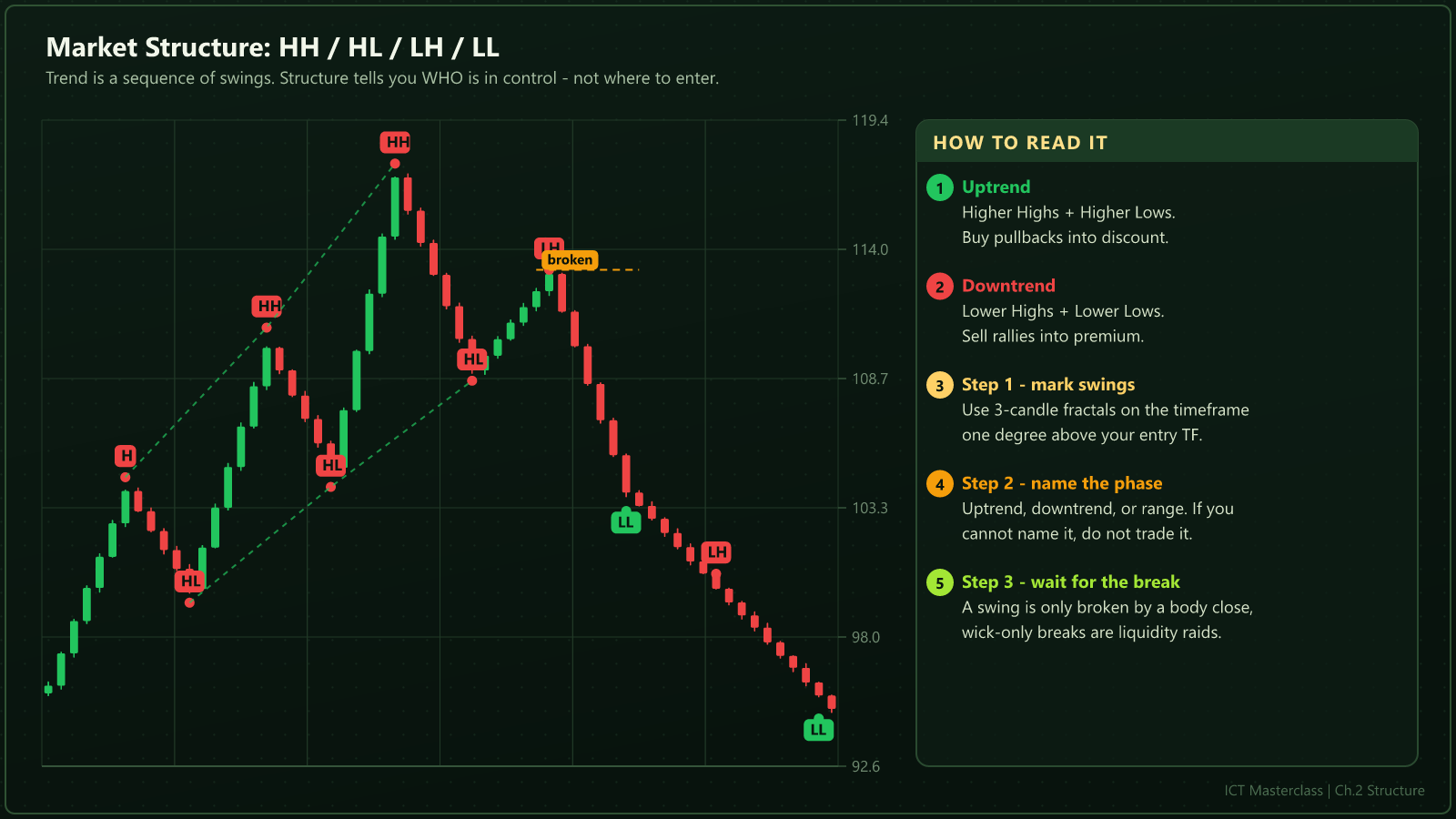
Uptrend = HH + HL. Downtrend = LH + LL. A range mixes HH with LH: neither side is consistent. Recognising that third state matters most, because ranges destroy the most traders.
2.2BOS - Break of Structure
A BOS is a body close beyond the previous swing high (in an uptrend) or swing low (in a downtrend). It proves the current delivery is still in force.
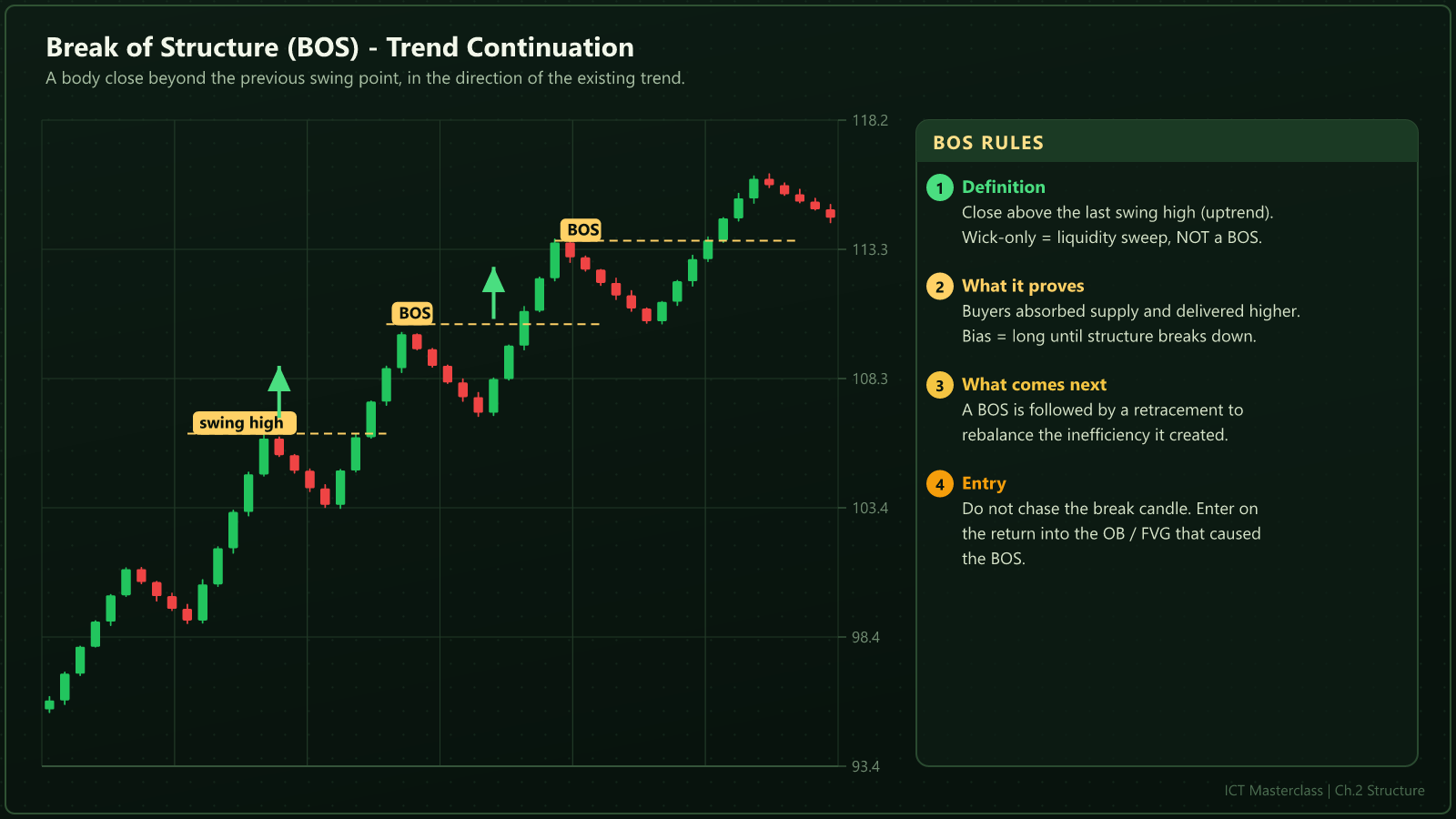
- A wick-only break is a sweep, not a BOS.
- After a BOS trade with the trend, but never enter on the BOS candle itself.
- A retracement follows a BOS almost always, because displacement leaves a gap.
- A higher-timeframe BOS is a bigger move. A 1-minute BOS does not flip a daily bias.
2.3CHoCH - Change of Character
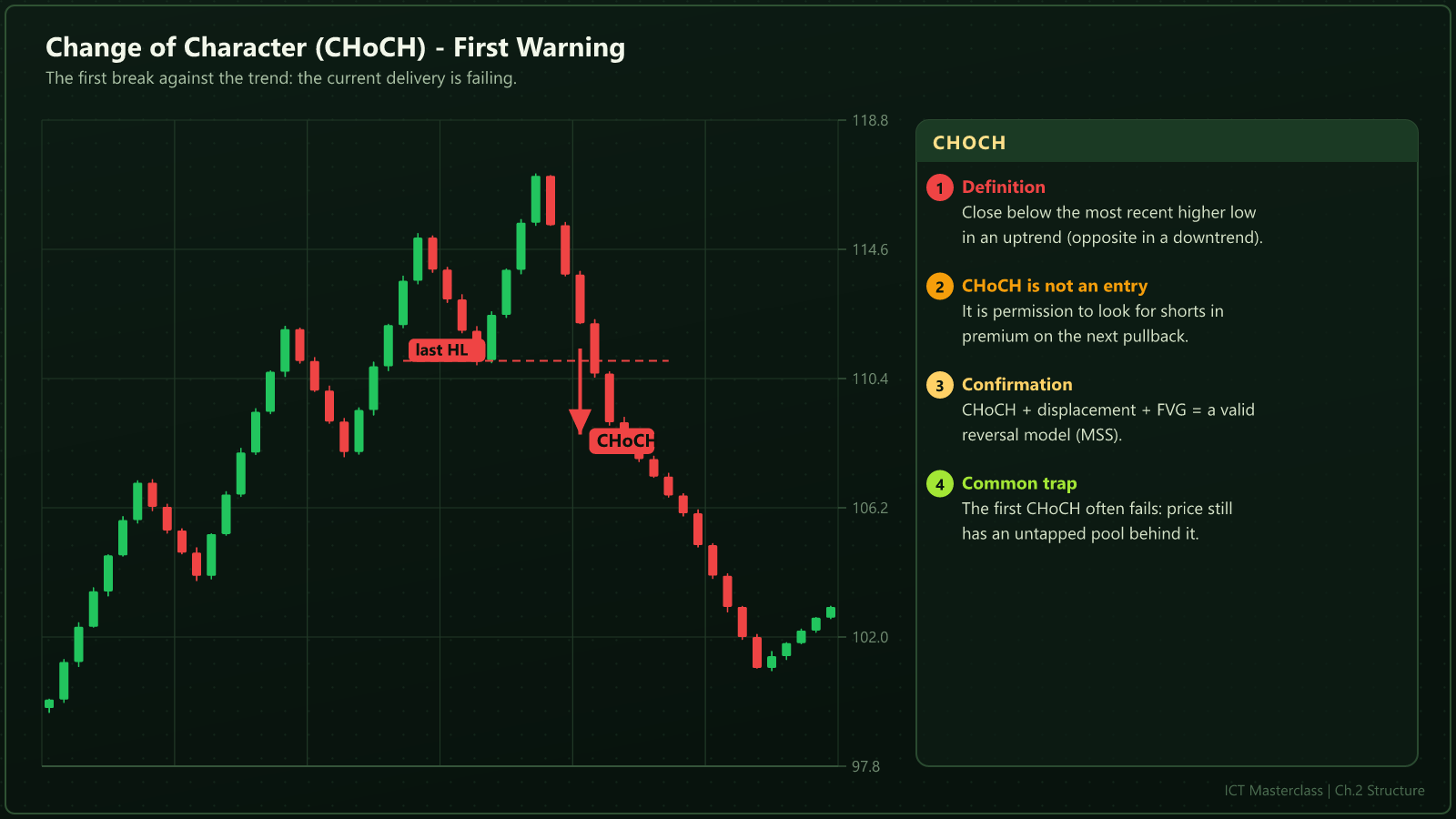
A CHoCH is the first break against the trend: in an uptrend, the last higher low fails. It is a hint that the trend is over, not proof.
2.4MSS - Market Structure Shift
MSS = CHoCH + displacement + FVG. This is where a complete entry model appears for the first time: price returns to the FVG, stop goes above the raid high, target is the opposite pool.
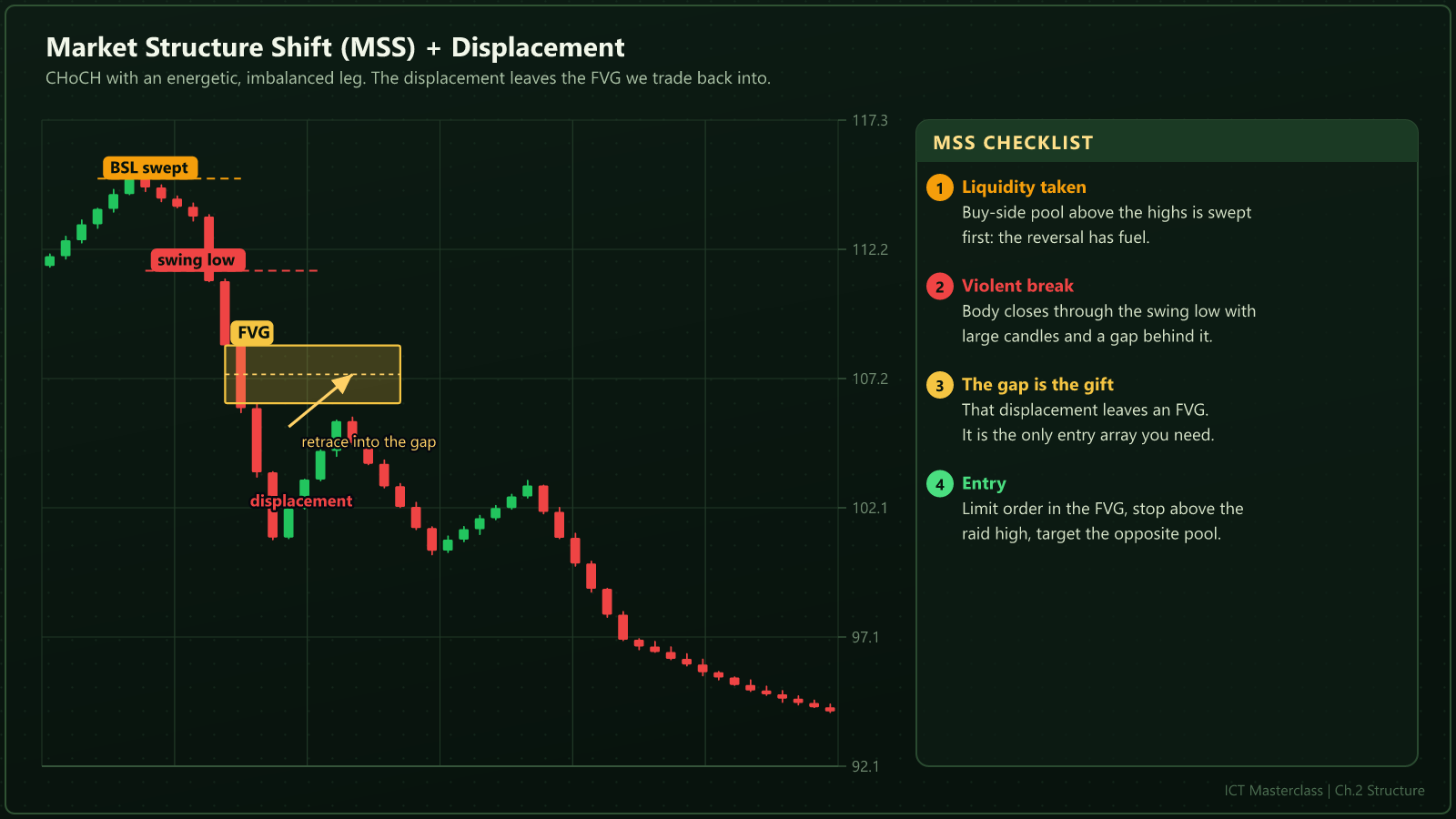
- Sweep: liquidity above or below has been taken.
- Displacement: big bodies break the structure.
- The gap: that displacement left an FVG.
- Return: price comes back to the FVG - that is your order.
2.5Internal Versus External Structure
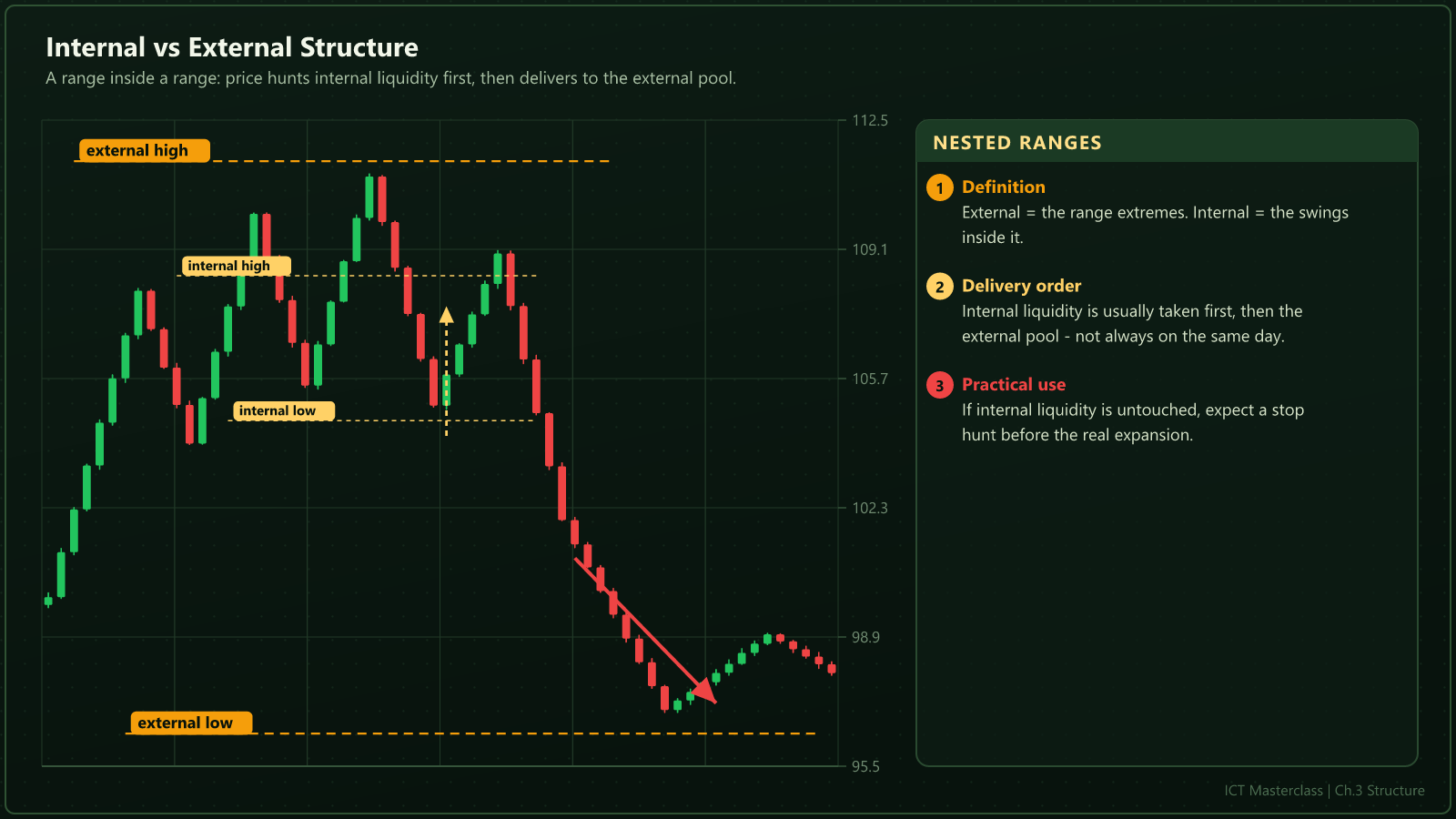
Every large range contains a smaller one. The outer boundary (range high/low) is external; the swings inside are internal. Price usually takes internal liquidity first, then delivers to the external pool.
| Situation | What to do |
|---|---|
Buy bias, price in discount | Look for a long on the FVG after an internal low sweep |
Buy bias, price in premium | Be patient; longs from premium offer poor R |
External high already taken | Bias neutral; find a new DOL |
2.6Mapping Structure By Hand
The correct order for marking structure: daily swings first, then 4H, then 1H. Each timeframe needs at least three swings - two highs and two lows.
- Timestamp every swing - structure without time is meaningless.
- Write the direction of the most recent BOS in the corner of the chart.
- Never mark more than three timeframes on one chart.
2.7Common Mistakes
| Mistake | Fix |
|---|---|
Treating every micro swing as structure | Only swings that hold liquidity matter |
Calling a wick break a BOS | Read the close, not the wick |
Flipping daily bias on the 1-minute | Bias changes only on daily or 4H |
Entering on the BOS candle | Wait for the retracement |
Educational material only · not financial advice.