CHAPTER 1
What Is ICT, Really?
ICT is not an indicator and not a signal service. It is a way of thinking: the market is not out to get you personally - it is collecting liquidity and delivering price from one pool to the next.
1.1Origins and the Core Idea
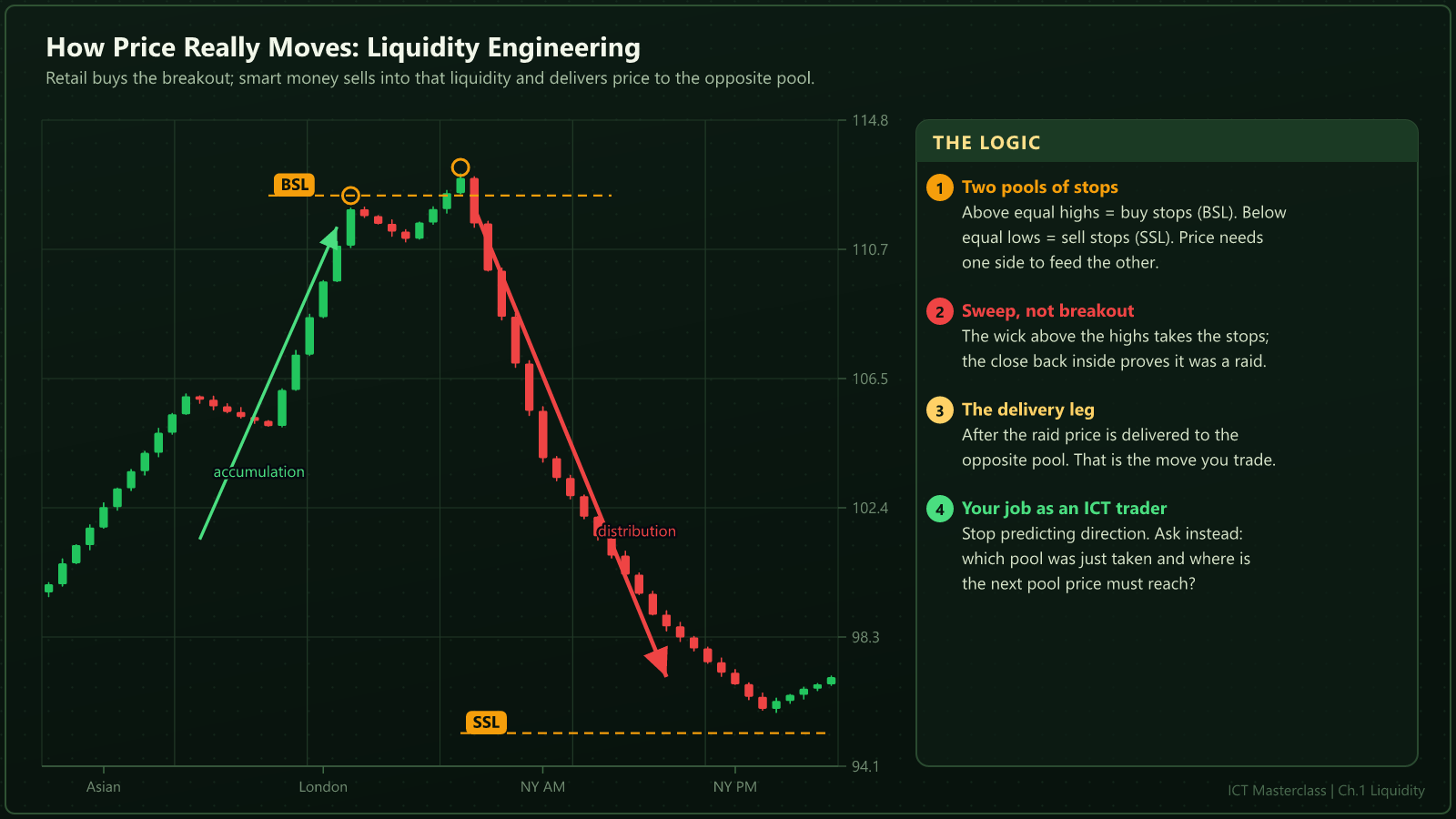
ICT (Inner Circle Trader) is the work of Michael J. Huddleston, who began publishing publicly around 2010. His central claim repeats everywhere: price is drawn to liquidity. The market first accumulates stops, then takes them (a sweep), then delivers the real move (displacement).
Understand this one sentence and you understand 80% of ICT: you are not trading direction, you are trading the journey from one liquidity pool to the next.
1.2IPDA - The Invisible Hand
IPDA stands for Interbank Price Delivery Algorithm. In plain words: a delivery mechanism that moves price to specific levels at specific times. It is not a conspiracy - large orders simply need liquidity, and the mechanism that finds it repeats the same patterns.
- Price is always drawn toward an old high or low, equal highs/lows, or a weekly/monthly range edge.
- Price does not deliver to both sides at once: one pool is taken first, the other later.
- Delivery happens through displacement, and displacement always leaves a gap (FVG).
- Delivery is time-bound: outside killzones price usually sleeps.
1.3Why Retail Traders Lose
The problem is not skill, it is perspective. Retail trades candle patterns, indicator crosses and headlines - but never asks where its stop has just been placed, and who wants to take it.
| What retail does | What smart money does |
|---|---|
Buys the breakout | Sells into the breakout (sweep) |
Buys support, stop under support | Drives price under the stops and takes them |
Trades any hour | Delivers inside killzones |
Predicts direction | Waits for a risk-defined price (discount) |
Wants fast money with big lots | Compounds consistency at 0.5% risk |
1.4What We Actually Look At: Four Pillars
| Pillar | Question |
|---|---|
Liquidity | Which pool gets taken first - above or below? |
Structure | Which way is structure, and where does it break? |
Time | Are we in a killzone - London or New York? |
Price / PD array | At which price do I enter - OB, FVG or OTE? |
A trade exists only when all four agree. If one is missing, wait. Waiting is also a position - it is called flat.
1.5Reading Candles: Spotting Displacement
ICT does not care about hammer or engulfing labels. It cares about body size and location. A large body, small wicks and a gap against the previous candle is displacement - institutional order flow.
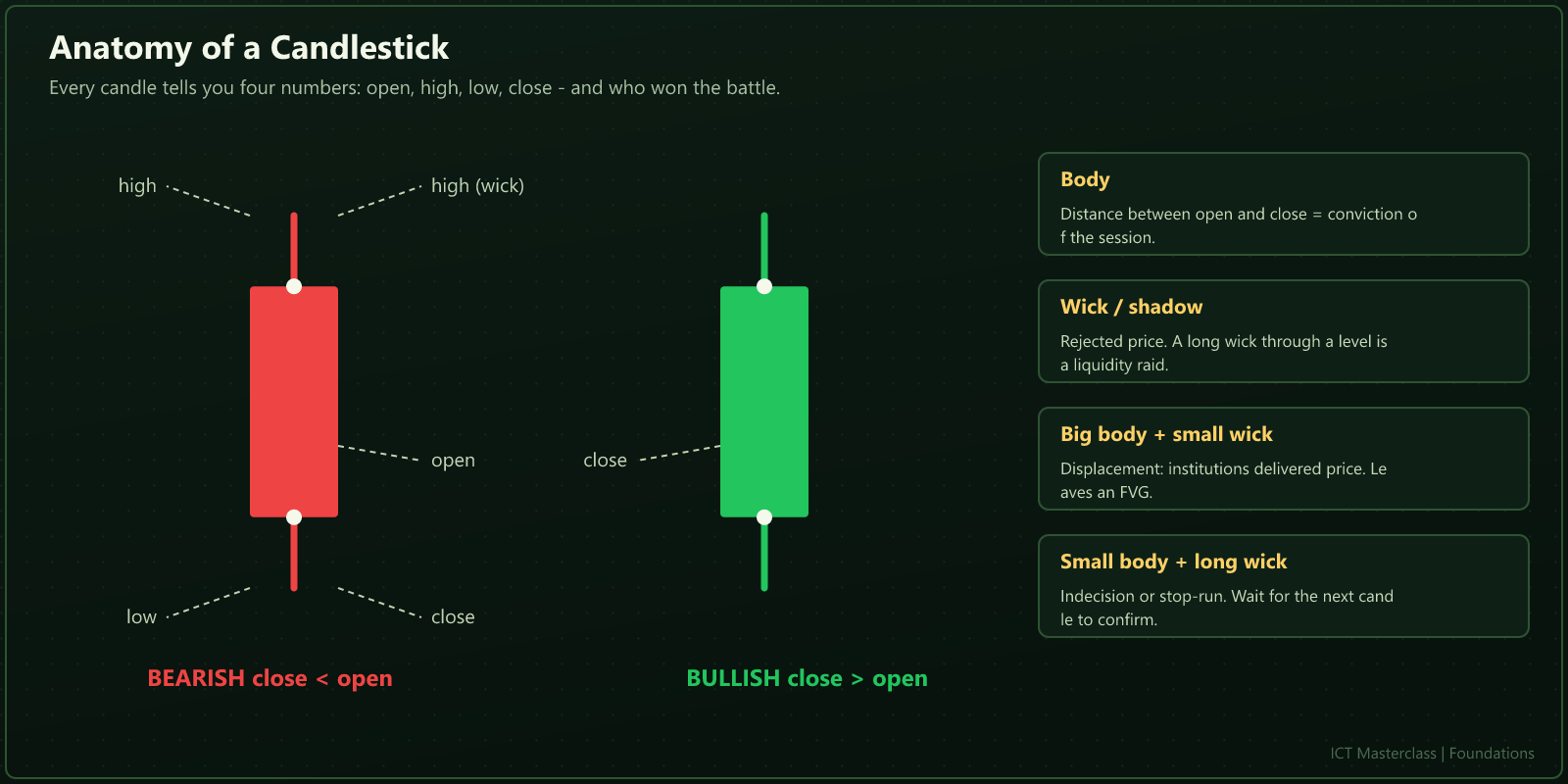
- Large body = conviction. If it leaves a gap behind, that gap is an entry zone.
- Long wick = rejection. Remember which level rejected it.
- Small body with wicks both sides = indecision; wait.
- Three to five large bodies in one direction = a delivery leg; do not fade it.
1.6The Timeframe Ladder
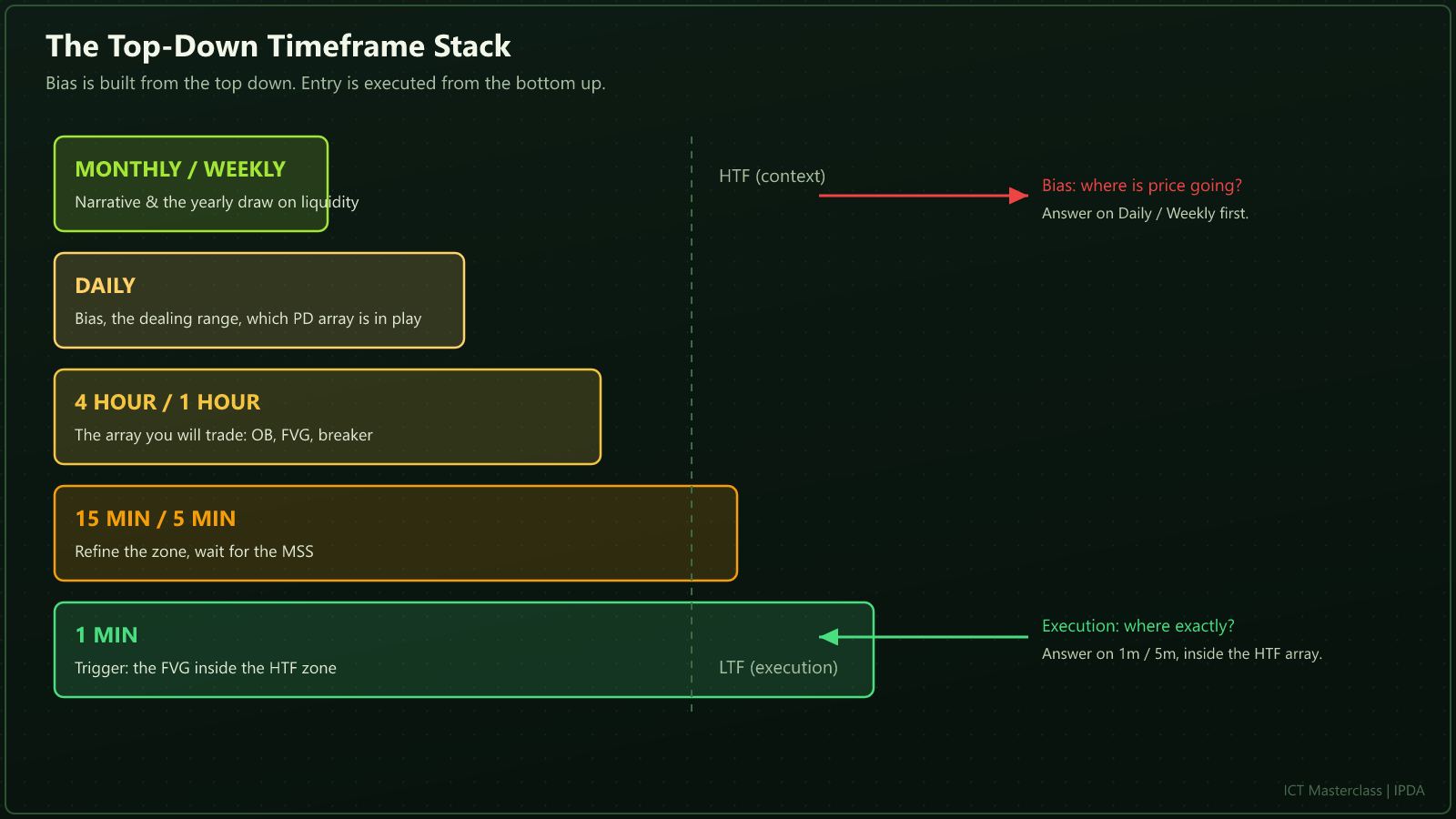
One rule: bias from the top, entry from the bottom. If you are bullish on the daily, shorting the 1-minute means fighting your own bias.
| Timeframe | What is decided |
|---|---|
Monthly / Weekly | The monthly draw and the narrative |
Daily | Bias, dealing range, which PD array is live |
4H / 1H | The zone you will actually trade |
15m / 5m | Market structure shift confirmation |
1m | Trigger: the FVG inside the HTF zone |
1.7What This Book Promises
This book will not make you profitable - no book can. It will give you a clear vocabulary, 20 tested models, and a checklist that replaces emotion with process. The rest is your screen time.
Educational material only · not financial advice.